
Call Now &
Get a Quote
Get a Quote

When it comes to reducing noise between floors, soundproofing underlayments are a practical solution. They not only minimize impact and airborne noise but also provide added benefits like cushioning, moisture resistance, and thermal insulation. Choosing the right underlayment depends on factors like sound ratings (STC and IIC), material composition, subfloor type, and local climate conditions. Here’s a quick rundown of the top options:
| Product | STC/IIC Ratings | Material | Moisture Resistance | Compatible Flooring |
|---|---|---|---|---|
| QuietWalk | STC 66 / IIC 71 | Recycled fiber | Built-in vapor barrier | Laminate, engineered wood, vinyl |
| FloorMuffler | STC 73 / IIC 74 | XLPP foam | Moisture-resistant | Hardwood, vinyl, tile |
| MuteMat 3 | STC 45 / IIC 48 | Foam + vinyl layers | Waterproof backing | Floating floors |
| Cork | STC 45-52 / IIC 50-65 | Natural cork | Moderate (antimicrobial) | Hardwood, engineered wood |
| Impacta | Varies (50-60+) | Recycled rubber | Naturally moisture-resistant | Wood, vinyl, tile, stone |
Each option has unique strengths, so consider your flooring type, noise reduction needs, and moisture concerns when selecting the best underlayment for your home.
When selecting a soundproofing underlayment, start by evaluating its performance ratings. Two key metrics to focus on are STC (Sound Transmission Class) and IIC (Impact Insulation Class).
The higher the ratings in these categories, the better the underlayment will be at controlling noise.
Your local climate and the type of subfloor you have also play a big role in choosing the right underlayment. For instance, in areas like the Bay Area, moisture and humidity can affect the durability and performance of the material. Subfloor types such as concrete, particle board, OSB, or plywood each have different levels of moisture resistance. Make sure to pick an underlayment designed to work with your specific subfloor to ensure long-lasting results.
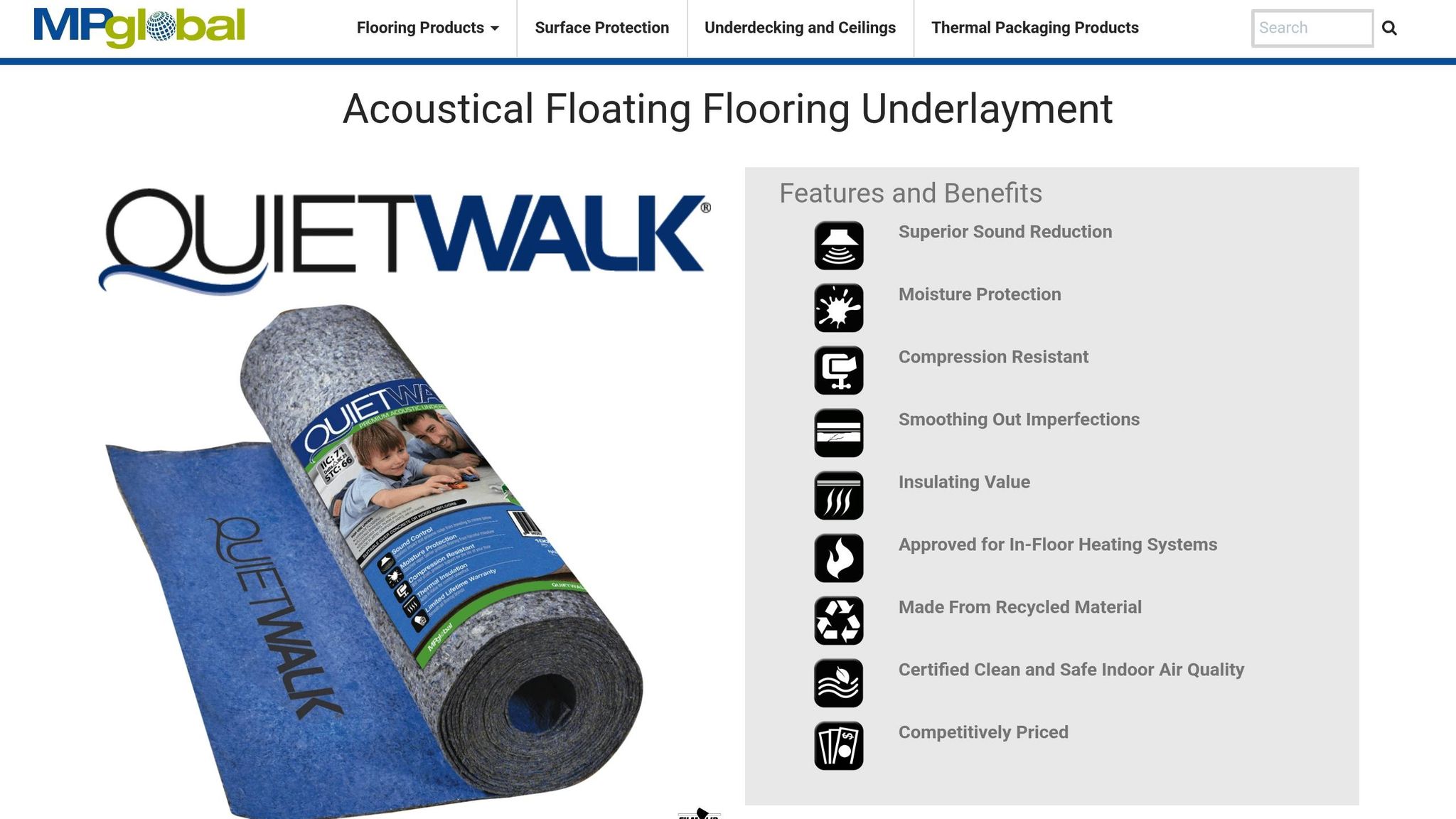
QuietWalk by MP Global Products has earned its place as a top choice for soundproofing underlayment, thanks to its ability to reduce noise effectively while being environmentally conscious. It's a popular option for homeowners who want quieter spaces without compromising on eco-responsibility.
QuietWalk delivers impressive soundproofing with an IIC rating of 71 and an STC rating of 66. The IIC rating measures how well it minimizes impact sounds like footsteps, dropped items, or moving furniture, while the STC rating evaluates its ability to block airborne noises such as conversations, music, or TV sounds. Additionally, its Delta IIC rating of 24 underscores its ability to reduce noise transmission when compared to an untreated floor.
Made from 95% post-industrial recycled fibers and processed recycled filaments, QuietWalk is designed to absorb sound efficiently while being environmentally friendly. These repurposed materials create a dense, sound-absorbing pad that enhances acoustic performance.
"The recycled filaments specially processed for QuietWalk provide superb cushion that helps to absorb sound and reduces unwanted noise. Floating floors sound more like fastened wood when you install QuietWalk flooring underlayment." – MP Global Products
QuietWalk also stands out for its durability, with a compression resistance of 85.5 psi, far exceeding the ASTM D1667 standard of 29 psi. This ensures the underlayment retains its structure under heavy foot traffic, preventing floor decoupling and maintaining its noise-reducing capabilities.
Equipped with a polyethylene vapor barrier, QuietWalk protects against moisture. This feature is particularly useful in areas with fluctuating humidity levels, making it a reliable choice for safeguarding various flooring types.
QuietWalk works seamlessly with floating floor systems, including laminate and engineered hardwood floors. It provides the right amount of cushioning to support these installations while maintaining stability.
Additionally, QuietWalk holds GREENGUARD GOLD certification for low emissions. This certification ensures a healthier indoor environment, making it a great option for families with children, elderly members, or individuals with respiratory concerns.
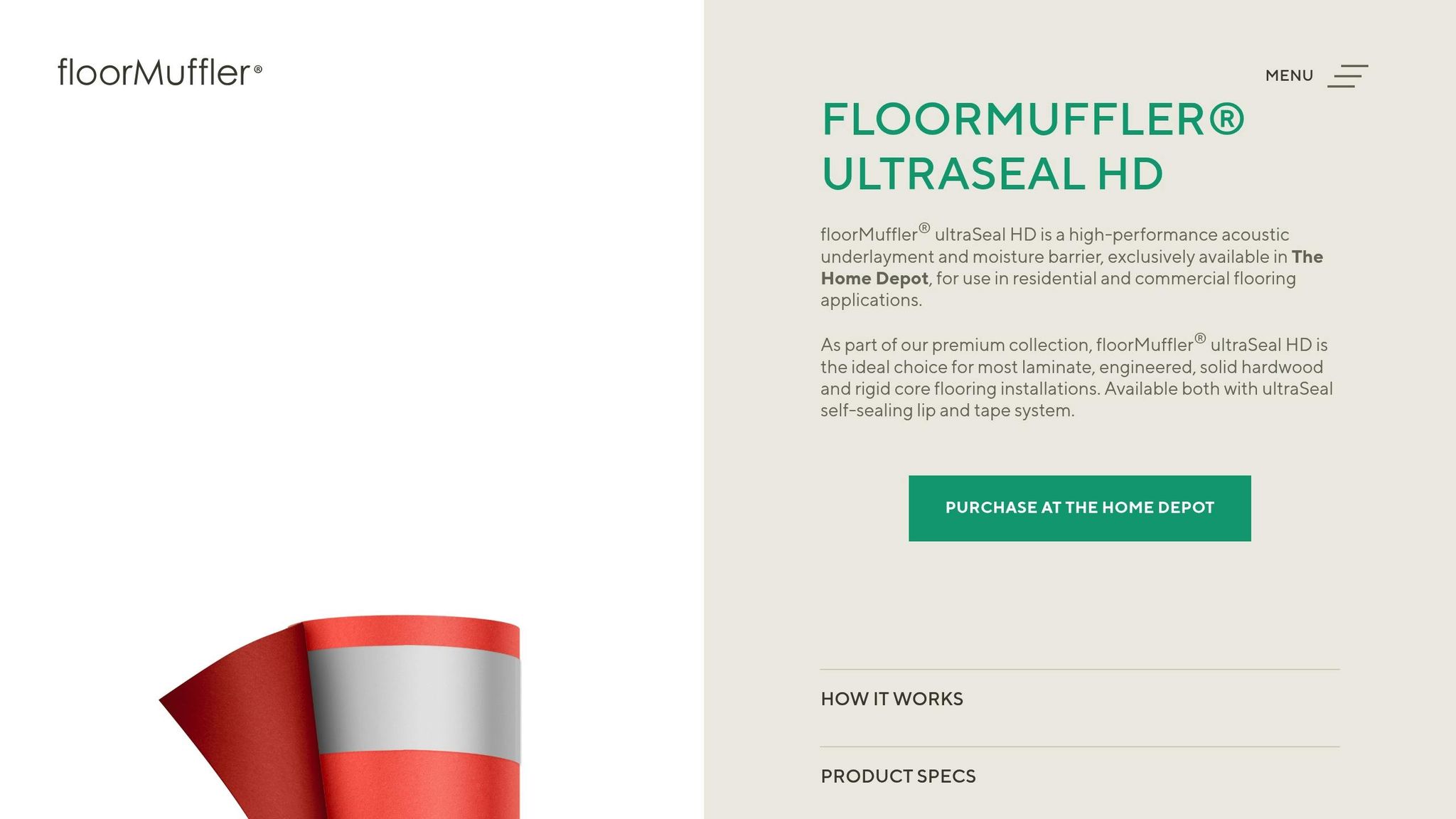
FloorMuffler® UltraSeal HD is a top-tier acoustic underlayment and moisture barrier that meets rigorous UBC standards, making it a dependable option for homeowners looking to minimize noise while protecting their flooring.
When it comes to soundproofing, FloorMuffler® UltraSeal HD delivers impressive results. It boasts an IIC rating of up to 74 decibels and an STC rating of up to 73 decibels. Additionally, its Delta IIC rating of up to 25 decibels highlights its ability to significantly cut down noise transmission between floors, offering a quieter and more comfortable living space.
This underlayment is crafted from XLPP foam with a closed-cell structure. This dense material creates an effective barrier against both airborne and impact noise, enhancing overall acoustic performance.
The closed-cell design isn't just about sound - it also provides excellent moisture resistance. This feature helps protect your subfloor and flooring, making it a smart choice for regions with fluctuating climates, like the Bay Area.

MuteMat 3 is a 12mm underlayment designed to tackle both impact and airborne noise. It's a solid choice for anyone looking to create a quieter indoor space.
This underlayment delivers an IIC rating of 48 and an STC rating of 45, effectively reducing impact noise by 48dB and airborne noise by 45dB. By addressing both sound types simultaneously, MuteMat 3 helps create a more peaceful environment.
MuteMat 3 owes its performance to a smart three-layer design. It features a core of closed-cell foam sandwiched between two layers of high-density mass-loaded vinyl. The grey vinyl layer works to dampen airborne sound, while the foam absorbs vibrations from impacts.
This underlayment works well with hard floor finishes like wood and laminate. To install it, start with a level and dry subfloor. Cut the material to fit, overlap the edges, and secure the joints with cloth tape. For a proper seal, install a perimeter band along the room's edges.
MuteMat 3 is crafted to meet the demands of Bay Area flooring projects, ensuring reliable acoustic performance when installed correctly. Following these steps will help you get the most out of its noise-reducing capabilities.
Cork underlayment is a natural choice for reducing sound transmission while offering environmentally friendly benefits. Made from the bark of cork oak trees, this renewable material delivers reliable acoustic performance across various flooring applications. It combines soundproofing qualities with practical installation perks, making it a strong contender for noise control.
Cork underlayment is highly effective at dampening both airborne and impact noises. Its performance improves with increased thickness and density, as its cellular structure contains tiny air pockets that trap and absorb sound.
Cork underlayment is created by compressing ground cork bark with resins, forming durable sheets or rolls. High-quality options often retain suberin, a natural waxy compound that offers antimicrobial properties and resists mold and mildew. Some versions also include a rubber backing, adding flexibility and durability.
Cork’s unique cellular structure and natural compounds make it resistant to moisture, though it’s not entirely waterproof. It handles everyday humidity and minor spills well. For spaces with higher moisture exposure, cork underlayments with built-in vapor barriers or rubber backing provide extra protection against subfloor moisture without sacrificing acoustic performance.
Cork underlayment is incredibly versatile, pairing seamlessly with hardwood, engineered wood, and laminate floors. Its cushioning effect reduces stress on floating floors and helps create a smoother, more uniform surface by masking slight subfloor imperfections. For vinyl plank flooring, thinner cork underlayment is ideal to ensure the locking mechanisms function properly, and it also allows for straightforward installation.
Impacta underlayment combines recycled materials with reliable sound control, making it a solid choice for homeowners who prioritize both performance and eco-consciousness. Its adaptability and focus on sustainability make it appealing for a variety of flooring and noise control needs.
The STC and IIC ratings for Impacta products depend on the specific model and installation. To understand how well a product will perform in reducing sound, it's best to review complete floor assembly test reports. Generally, building codes call for a minimum IIC rating of 50 for effective soundproofing, though high-end installations often aim for ratings in the upper 50s or lower 60s.
Impacta's dedication to sustainability shines through in its material choices. For instance, the Impact Barrier QT product contains 92% recycled rubber, while other offerings in the line utilize 100% post-consumer recycled SBR tire rubber. This recycled rubber base is not just environmentally friendly - it’s also highly functional. It offers the density and flexibility required for effective sound dampening, all while diverting waste from landfills. The durable construction absorbs impact energy, reduces sound transmission, and ensures consistent acoustic performance over time. Plus, its design is compatible with a variety of flooring systems, making it a practical solution for many homeowners.
Impacta underlayment is engineered to work seamlessly with a wide range of flooring materials, including wood, carpet, vinyl, tile, and luxury vinyl tile (LVT). Specific products like the Impact Barrier QT are ideal for hardwood, tile, carpet, laminate, and stone installations. The product line also caters to specialized flooring needs, such as engineered wood, parquet, ceramic tile, stone, brick, marble, and pavers. For sheet vinyl, linoleum, and luxury vinyl tiles, the Impacta ProBase Vinyl system is specifically designed to deliver optimal results.
This versatility means you can use Impacta underlayment throughout your home, even if you’re mixing different types of flooring. It ensures consistent acoustic performance, no matter the material, creating a quieter and more comfortable living environment.
Here’s a quick look at the underlayments mentioned earlier, summarizing their key features, specifications, and compatibility.
| Product | STC/IIC Ratings | Material Type | Thickness | Moisture Resistance | Flooring Compatibility |
|---|---|---|---|---|---|
| QuietWalk | IIC 67-71, STC 53-56 | Recycled fiber with moisture barrier | 3mm | Excellent (built-in vapor barrier) | Laminate, engineered wood, luxury vinyl |
| FloorMuffler | IIC 65-72, STC 50-58 | High-density fiber composite | 2mm-3mm | Good (moisture-resistant coating) | Hardwood, laminate, vinyl, tile |
| MuteMat 3 | IIC 66-74, STC 52-59 | Dense fiber with polymer backing | 3mm | Excellent (waterproof backing) | All floating floors, radiant heat compatible |
| Cork Underlayment | IIC 50-65, STC 45-52 | Natural cork granules | 3mm-6mm | Moderate (naturally antimicrobial) | Hardwood, laminate, engineered wood |
| Impacta | IIC 50-60, STC varies | Recycled rubber (92-100% recycled) | 2mm-6mm | Good (rubber naturally resists moisture) | Wood, carpet, vinyl, tile, LVT, stone |
Choosing the right soundproofing underlayment can feel overwhelming, but if you're in the Bay Area, you're in luck. Elephant Floors' Sunnyvale showroom offers not just products but also expert guidance tailored to local acoustic challenges.
At the showroom, you'll find specialists who understand the unique soundproofing needs of multi-story condos and older homes in the region. They’ll help you navigate technical details like IIC ratings and material compatibility, ensuring your choice aligns with your flooring type and noise reduction goals. This one-on-one guidance connects the technical aspects with your practical needs.
One standout feature is the availability of free samples. You can take materials like QuietWalk, FloorMuffler, or MuteMat 3 home to test their thickness, texture, and soundproofing performance in your space. Combine this hands-on testing with the showroom's expert advice, and you'll have a clear picture of what works best for you. Delivery services make it even easier to evaluate your options from the comfort of your home.
Beyond product selection, Elephant Floors also offers professional floor measurements and detailed proposals designed to meet your specific soundproofing requirements. Their team’s expertise ensures that every recommendation factors in your flooring choice, subfloor conditions, and acoustic needs.
Named Best Flooring Store of Sunnyvale 2022, Elephant Floors has earned a reputation for exceptional service. Their showroom experience is designed to help you explore premium soundproofing options that work seamlessly with flooring types like hardwood, laminate, and luxury vinyl - all specialties of Elephant Floors.
Ready to get started? Book a free appointment to discuss your needs, get expert advice, and design a soundproofing solution tailored just for you.
Choosing the right soundproofing underlayment does more than just reduce noise - it enhances your overall living experience. Among the options we've discussed - QuietWalk, FloorMuffler, MuteMat 3, Cork Underlayment, and Impacta - each caters to specific needs, whether it's minimizing footfall noise or creating an ideal space for a home theater. The right underlayment not only dampens sound but also improves comfort and supports better flooring performance.
While technical ratings like IIC and STC provide a starting point, achieving the best results requires careful consideration of factors like density, thickness, and material composition. The interaction between your subfloor (be it concrete or plywood) and your flooring type (hardwood, laminate, or luxury vinyl) plays a significant role in soundproofing performance. It's this combination that determines how effectively the underlayment reduces noise in real-world conditions.
Once you've selected the appropriate underlayment, proper installation becomes critical. Soundproofing isn't as simple as it might seem, and professional expertise can make all the difference. Skilled installers assess your home's layout, address noise challenges, and ensure compatibility between your flooring and underlayment. They also tackle specific issues, such as moisture resistance for basements or managing low-frequency vibrations in new constructions.
The installation process itself can significantly impact the effectiveness of your investment. Professionals not only avoid common mistakes but also use techniques that maximize the durability and performance of your underlayment. Their knowledge ensures that your soundproofing solution delivers the results you expect.
For those in the Bay Area, Elephant Floors offers a comprehensive service that combines technical expertise with local insight. They provide consultations, hands-on product testing, and professional installation, along with personalized advice and free samples, helping you create a quieter, more comfortable home.
When selecting the appropriate STC (Sound Transmission Class) and IIC (Impact Insulation Class) ratings for your subfloor, it’s important to assess your specific noise reduction needs. Here’s a quick breakdown:
If you’re designing a residential space where tranquility is a priority, these ratings are a good benchmark. By addressing both airborne and impact noise, you can create a quieter, more comfortable living environment.
Yes, soundproofing underlayments are compatible with a wide range of subfloor types, including wood, concrete, and plywood. These underlayments are specifically designed to help reduce noise across different surfaces, making them a flexible choice for various flooring setups.
That said, the effectiveness of an underlayment often depends on the subfloor it’s paired with. For instance, denser and thicker underlayments generally deliver better sound reduction. However, materials like concrete and plywood can interact differently with certain underlayments, which might affect the level of noise reduction you achieve. Selecting the right underlayment for your specific subfloor is essential to maximize soundproofing results.
When deciding between natural and synthetic underlayments, there are a few key factors to consider: durability, impact on the environment, and how well they handle moisture. Natural options like cork or wool are breathable and eco-conscious, making them a solid pick for anyone focused on sustainability. That said, they might not hold up as well against moisture or wear and tear over time.
Synthetic underlayments, on the other hand, shine in terms of durability and moisture resistance, delivering reliable long-term performance. They’re a smart choice for spaces with high humidity or heavy foot traffic. However, in persistently damp areas, they could trap moisture, which is something to keep in mind. Your final decision should reflect your priorities, whether that’s reducing noise, staying environmentally mindful, or adapting to your home’s specific climate conditions.
Leave a comment