
Call Now &
Get a Quote
Get a Quote

The best flooring for a school gym basketball court depends on balancing performance, safety, durability, and budget. Here's a quick breakdown of the top options:
| Flooring Type | Lifespan | Cost (per sq. ft.) | Best For |
|---|---|---|---|
| Maple Hardwood | 40–50+ years | $10–$20 | Varsity games, competition courts |
| Cushioned Sports Vinyl | 15–30 years | $5–$12 | Multi-use K–12 gyms |
| Poured Polyurethane | 10–20 years | $8–$15 | Multi-sport, high-traffic gyms |
| Luxury Vinyl Tile (LVT) | 10–25 years | $6–$12 | Auxiliary gyms, light basketball use |
| Rubber/Modular Tiles | 10–20 years | <$8 | Elementary/multi-purpose gyms |
| Laminate Flooring | 5–10 years | $2–$4 | Light-use practice or auxiliary spaces |
For high-performance basketball, maple hardwood is the best choice. For budget-conscious schools, sports vinyl, polyurethane, or LVT offer a mix of affordability and durability. Modular tiles and rubber work well for safety-focused, multi-purpose spaces. Assess your gym's primary use, budget, and maintenance capacity before deciding.
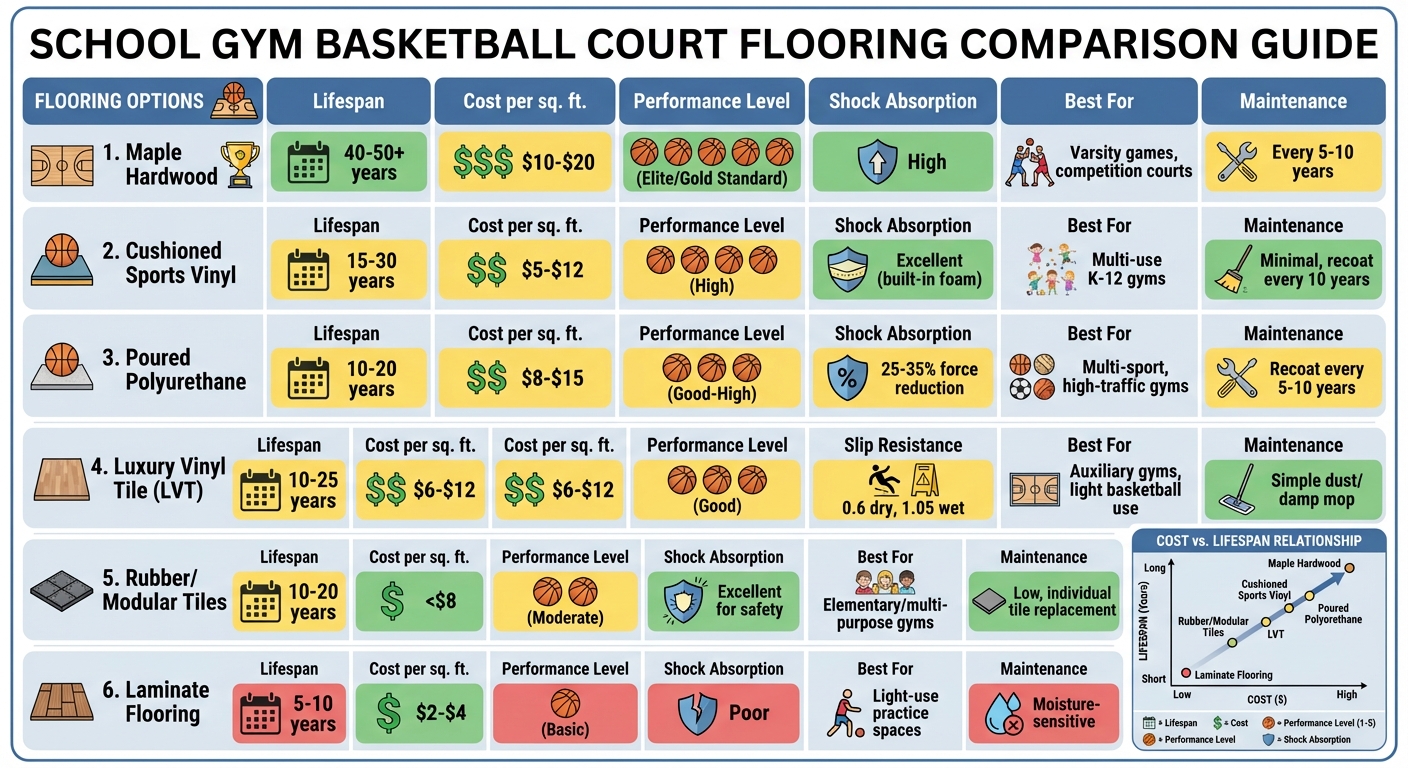
School Gym Basketball Court Flooring Comparison: Cost, Lifespan, and Performance
Maple hardwood is a standout choice for sports flooring, offering excellent shock absorption when installed over a well-designed subfloor. When paired with floating or anchored-resilient systems, it delivers the force reduction athletes need while maintaining the responsiveness required for quick movements and jumps. The surface strikes a balance between grip and slide - enough traction to prevent slipping, but just enough glide to avoid skin burns or abrupt stops. These qualities make maple hardwood a top contender for durability and performance.
With proper installation and care, a maple floor can last an impressive 40–50 years or more, often serving multiple generations. Its tight, uniform grain structure resists dents and wear from heavy use, whether it’s from constant foot traffic or ball impacts. However, consistent maintenance is key to preserving its performance. Without it, the finish can deteriorate, leading to costly repairs.
For basketball courts, maple hardwood is the industry gold standard, trusted by the NBA, NCAA, and FIBA. Its surface ensures consistent ball bounce and reliable traction, enabling quick pivots and cuts. For example, Connor Sports' Focus flooring system, which is the official court for NCAA March Madness and the Final Four, is celebrated for its superior vibration control and ball response.
While installation costs for maple hardwood are on the higher side due to premium materials and specialized labor, its longevity can make it a cost-effective option in the long run. Unlike synthetic floors that often require full replacement every 10–30 years, maple’s lifespan significantly reduces life-cycle costs. Opting for Second Grade maple can also help manage costs without compromising on performance.
Proper installation is crucial to unlocking the full potential of maple hardwood. Partnering with specialized flooring providers ensures the subfloor is designed correctly, moisture levels are controlled, and the right finish is applied. In the San Francisco Bay Area, Elephant Floors offers expert installation services tailored to meet the demands of schools and facilities that require durable, high-performance sports flooring.
Maple hardwood might be the gold standard for gym floors, but cushioned sports vinyl is a fantastic, budget-friendly alternative that doesn’t skimp on performance. Thanks to its engineered foam underlayments, this flooring offers built-in shock absorption, providing excellent joint protection. Unlike natural wood, which can vary in impact reduction depending on the subfloor system, cushioned vinyl delivers consistent results. Products like Tarkett's Omnisports with LumaFlex underlayment combine this cushioning with the uniform surface schools need for multi-sport activities. It’s a practical solution that balances high-level performance with easy everyday upkeep.
One standout feature of cushioned sports vinyl is its slip resistance, especially under wet conditions. With coefficients of 0.6 when dry and 1.05 when wet (for rubber soles), it even outperforms some sealed wood floors when moisture is present.
Sean DeVore of Mannington Commercial highlights that vinyl, when installed with epoxy adhesive, not only matches the performance of wood but also offers better slip resistance and requires less maintenance.
Durability is another major perk. Cushioned vinyl is tough enough to resist stains, moisture, and heavy foot traffic, with a lifespan ranging from 10 to 30 years. Maintenance is straightforward - just sweep or mop with a mild detergent. Plus, it only needs a polyurethane spray recoating every decade, cutting long-term maintenance costs by 50–70% compared to wood floors, which require annual recoating.
Performance-wise, cushioned vinyl holds its own. It delivers consistent ball bounce and balanced traction, making it perfect for basketball and versatile enough for volleyball and other gym sports. Tarkett's PolyTurf Plus systems, for instance, are highly regarded for basketball courts, offering a combination of vinyl surfaces with padding or poured systems that mimic the performance of hardwood in non-professional settings.
Beyond performance, cushioned sports vinyl is a winner in terms of cost and installation. At $5–$10 per square foot, it’s a more affordable option than maple hardwood. For a typical 4,000-square-foot school gym, costs range from $20,000 to $40,000 depending on the brand and cushioning thickness. Installation is also quicker - often completed in just a few days with glue-down or loose-lay methods over a flat subfloor. For example, Danville High School in Illinois installed 33,000 square feet of PolyTurf Plus in 2021, while Clearview Durling Middle School in Ohio opted for 8,400 square feet of elastic cushioned vinyl for their multi-use gym in July 2021.
For schools in the Bay Area looking for durable, cost-effective sports flooring, Elephant Floors offers tailored services designed to meet the needs of educational facilities demanding high-performance surfaces.
Poured polyurethane systems are seamless synthetic surfaces that combine a resilient rubber underlayment with a self-leveling polyurethane wear layer. These joint-free surfaces are gaining traction in U.S. school gyms, which often serve as multipurpose spaces for assemblies, dances, and physical education. Their seamless design promotes both safety and performance.
One standout feature is their ability to reduce force by 25–35% (or more). By adjusting the thickness of the underlayment, these floors can provide tailored cushioning to protect athletes while maintaining proper ball response. The seamless nature of the surface ensures consistent slip resistance and eliminates the uneven spots commonly found in wood or tile joints.
These floors are also highly durable, resisting moisture, stains, and heavy loads. Thanks to their non-porous, seamless design, spills are easily repelled, and maintenance is straightforward - regular cleaning and a recoat every 5–10 years help keep long-term upkeep costs low.
Poured polyurethane systems meet EN/DIN standards for ball bounce (≥90–95%), providing reliable traction and performance. While they may not replicate the feel of hardwood for elite-level play, they are well-suited for K–12 programs and community leagues. Additionally, the uniform surface allows for clear marking of multiple sports lines without the issue of ghosting.
In terms of cost, poured polyurethane ranges from $8–15 per square foot for a 4,000–7,000 square-foot gym. When factoring in lower maintenance expenses over time, this option often proves more budget-friendly than maple hardwood. Installation typically takes 3–7 days on a properly leveled and moisture-mitigated subfloor, and it’s a job best handled by experienced contractors. For schools in the Bay Area planning broader flooring projects, local providers like Elephant Floors can help ensure smooth transitions between polyurethane sports flooring and other campus flooring types.
Luxury Vinyl Tile (LVT) is becoming a popular choice for K–12 school gyms that want the look of wood without the hefty price tag or the demanding upkeep of maple. It offers an appealing and budget-friendly alternative, particularly for multi-purpose gyms. While LVT doesn’t provide the same shock absorption as sprung maple or specialized sports vinyl systems, it still performs well for PE classes, intramurals, and recreational basketball. Its combination of visual appeal and functional performance makes it a strong contender among synthetic flooring options.
Commercial-grade LVT designed for athletic use typically includes wear layers ranging from 20 to 40 mil, making it resistant to scuffs, scratches, and stains, even in high-traffic areas. Its moisture-resistant surface helps prevent issues like warping or cupping, which are common with hardwood in humid environments. Mannington Commercial notes that basketball-grade LVT achieves a 0.6 dry and 1.05 wet coefficient of friction with rubber-soled shoes, potentially outperforming polyurethane-sealed wood floors in terms of slip resistance.
Sean DeVore of Mannington explains, "LVT flooring isn't any different from wood in performance", as long as it's installed using a high-strength epoxy adhesive.
Maintaining LVT is simple: daily dusting and occasional damp mopping are enough to keep it in good shape throughout its 10–20+ year lifespan. For gyms seeking added shock absorption, many schools choose to install LVT over a resilient underlayment. Without this, direct installation on concrete can lead to a firmer, less forgiving feel.
LVT also stands out for its versatility and durability, making it a great fit for gyms with varied uses. The installed cost typically falls between $6 and $12 per square foot, which makes it a cost-effective solution for schools. Additionally, LVT offers design flexibility, allowing schools to incorporate logos, mascots, and multi-color court markings directly into the flooring for long-lasting branding. For schools in the Bay Area, local providers like Elephant Floors in Sunnyvale can assist with installations, offering access to a range of commercial-grade options.
When evaluating LVT, facility managers should consider their gym's primary activities. LVT works well for elementary and middle schools with diverse programs and occasional basketball games. However, for gyms with heavy practice schedules or competitive gameplay, the superior ball response and shock absorption of maple or poured polyurethane systems may still be the better choice.
Laminate flooring is an affordable option that delivers a wood-like appearance, typically costing between $2–$4 per square foot. However, when it comes to competitive basketball, it falls short in key performance areas. It lacks the shock absorption and consistent ball response necessary for high-level play. Most laminate products are designed for residential or light commercial use, not for the demands of sports. Unlike maple hardwood or cushioned vinyl systems, laminate flooring doesn’t have the built-in engineering required for durability, safety, and performance.
One of the biggest drawbacks is its safety and playability. Without proper underlayment, laminate flooring does not meet DIN or ASTM standards for sports surfaces. When installed directly over concrete or with only a thin foam underlayment, it feels significantly harder than maple on resilient pads or cushioned vinyl. This lack of shock absorption can lead to discomfort or even injury during play. Additionally, surface friction can vary depending on the finish, which may affect player movement and raise the risk of accidents.
Durability is another concern, especially in high-traffic gym environments. While the wear layer resists scratches, the HDF core is highly sensitive to moisture. Exposure to water can cause swelling and buckling, often requiring full board replacement. Heavy equipment like retractable bleachers or portable stages can also leave indentations or damage the joints. These issues make laminate less practical for spaces that see rigorous sports activity.
That said, laminate flooring does have its place in certain situations. In multi-purpose rooms or auxiliary gyms where basketball is played only occasionally, it can be a budget-friendly choice. Its low upfront cost and simple maintenance - regular dust mopping and occasional damp mopping - make it suitable for areas where performance isn’t the top priority. For spaces like hallways or rooms with occasional sports use, laminate offers an economical solution with a polished, wood-like appearance.
For schools in the Bay Area exploring flooring options, Elephant Floors in Sunnyvale can be a helpful resource. They provide free samples and expert advice on hardwood, vinyl, and laminate solutions. Their team can guide you through comparing costs, maintenance needs, and performance to determine if laminate is the right fit for your gym.
When it comes to synthetic flooring options, rubber and modular sport tile systems provide schools with a practical balance between cost and performance. These systems are particularly suited for schools juggling budget limitations while still needing reliable and safe gym flooring. Rubber flooring comes in two forms - rolled sheets or interlocking tiles - often made from recycled rubber. This creates a durable, shock-absorbing surface that’s perfect for elementary and multi-use gyms, where safety is a top priority. On the other hand, modular sport tiles, typically made from polypropylene or PVC, snap together without adhesives, making them a great choice for secondary courts, outdoor play areas, and auxiliary spaces where durability and easy installation are key.
Both flooring systems prioritize safety and shock absorption, but rubber tends to offer better impact protection. High-density rubber tiles are especially effective at cushioning falls and reducing joint strain, making them ideal for younger students and general physical education activities. Modular sport tiles, however, can be enhanced with built-in shock pads or underlayments. For instance, systems like Tarkett's PolyTurf Plus boast shock absorption ratings of 9+2 mm, meeting multi-sport standards. These features make both options versatile for various athletic and recreational needs.
When it comes to basketball performance, the two systems differ slightly. Rubber flooring offers excellent traction and grip, which is beneficial for younger players. However, its "sticky" feel may not appeal to athletes accustomed to traditional hardwood courts, as it can result in a lower and less responsive ball bounce, impacting dribbling and gameplay. Modular sport tiles, designed specifically for court sports, provide more consistent ball rebound and lateral stability, closely mimicking traditional court surfaces. Their textured surfaces deliver the traction needed for quick cuts and pivots, making them a strong choice for organized basketball programs. While neither system can replicate the performance of premium maple flooring, both offer solid alternatives with easier maintenance.
Speaking of maintenance, both rubber and modular sport tiles are known for their durability and ease of care. Rubber flooring resists wear, impacts, and abrasion from heavy equipment and bleachers. It requires only regular sweeping, vacuuming, and damp mopping with neutral cleaners. However, care should be taken to avoid damage from sharp objects or harsh chemicals. Modular sport tiles, made from rigid polypropylene, are equally durable and allow for individual tile replacement if damage occurs - an especially valuable feature for outdoor installations. Routine care for both systems includes dust mopping, scrubbing, and periodic inspections to ensure interlocking components stay secure. Over time, rubber may show surface wear but remains functional, while modular tiles tend to maintain performance, though outdoor versions may experience some UV-related discoloration.
Cost and installation also make these systems appealing for budget-conscious schools. Rubber flooring is moderately priced and can often be installed over existing, level concrete slabs with minimal preparation. Modular sport tiles, with their snap-together design, require even less labor during installation, making them an affordable option for schools with tight budgets or phased upgrade plans. However, both systems rely on a properly prepared base. Any slopes, cracks, or drainage issues must be addressed beforehand, which can add to the overall cost, especially for outdoor setups.
For schools in the Bay Area exploring gym flooring options, Elephant Floors in Sunnyvale offers free samples and expert guidance to help you make an informed decision.
Here’s a comparison of six popular gym flooring options based on safety, durability, basketball performance, cost, and their ideal applications. Each type has its own strengths and trade-offs, so choosing the right one depends on your specific needs.
| Flooring Type | Safety | Durability & Lifespan | Basketball Performance | Cost | Best For |
|---|---|---|---|---|---|
| Maple Hardwood | High – Natural shock absorption and balanced friction; can become slippery if finish wears out | Lasts 40–50+ years with proper maintenance | Elite – Excellent ball bounce and surface friction, ideal for competitive basketball | $$$ – High upfront and maintenance costs but offers great long-term value | High school varsity gyms, competition courts, and tournament venues |
| Cushioned Sports Vinyl | High – Designed for shock absorption and slip resistance | Lasts 15–30 years depending on thickness; requires minimal maintenance | Mimics hardwood feel, though some players notice slight differences | $$ – Lower installation cost with good overall value | Multi-purpose K–12 gyms balancing affordability with performance |
| Poured Polyurethane | Seamless shock layer reduces injury risk and fatigue; traction is customizable | Durable under heavy use; easy cleaning with occasional recoating | Adaptable for various sports; customizable performance | $$ – Moderate upfront cost with minimal long-term maintenance | Facilities that prioritize safety and multi-sport versatility |
| Luxury Vinyl Tile (LVT) | Slip-resistant with a slip coefficient of 0.6 (dry) and 1.05 (wet) | Lasts 15–25 years; resists moisture and stains; individual tiles are replaceable | Performs similarly to wood when installed with epoxy adhesive | $$ – Competitive pricing, no refinishing required, and easy to repair | Smaller high schools and auxiliary gyms wanting a wood-like look with lower upkeep |
| Laminate Flooring | Less forgiving underfoot; harder surface compared to sports-specific options | Shorter lifespan under heavy use; prone to wear and moisture issues | Adequate grip but less consistent ball bounce than specialized sports flooring | $ – Lowest initial cost but may need frequent replacement | Light-use practice courts, multi-purpose rooms, and fitness spaces |
| Rubber & Modular Tiles | Excellent impact absorption and slip resistance, ideal for younger athletes | Lasts 10–20 years; tiles are replaceable | Provides decent ball bounce and traction, though not suitable for competitive basketball | $$ – Mid-range cost with low maintenance | Elementary schools, middle schools, community centers, and outdoor play areas |
This breakdown highlights how different flooring options cater to various needs. For top-tier basketball performance, maple hardwood stands out. Cushioned sports vinyl and poured polyurethane are excellent for multi-purpose gyms, blending safety and performance at a lower cost. LVT offers a balance of aesthetics and affordability, while laminate flooring works best for spaces with lighter use. Lastly, rubber and modular tiles provide safety and versatility, making them a great choice for younger athletes and community spaces.
If you’re unsure about the best fit for your gym, companies like Elephant Floors in Sunnyvale offer free samples and expert advice to help you find the perfect solution.
Selecting the best flooring for your school gym basketball court means balancing performance, safety, and cost. For high school gyms hosting varsity games or tournaments, maple hardwood is often the top choice. Its superior ball bounce, grip, and overall player experience make it a favorite for competitive play. Plus, with proper care, a maple court can last 40–50 years, making it a solid long-term investment.
For gyms with diverse programs or heavy daily use, there are other great options. Cushioned sports vinyl, poured polyurethane, or LVT offer a mix of shock absorption and playability while standing up to wear and tear. If your school is working with a tighter budget, rubber flooring and modular sport tiles provide durability, easy maintenance, and safety for younger athletes, even though they can't match the high-level performance of hardwood.
Don’t overlook local climate and building conditions. In areas like the SF Bay Area, where humidity levels can fluctuate or buildings may have older infrastructure, synthetic flooring like vinyl or polyurethane is often a more stable choice. These materials resist warping and handle environmental changes better than solid maple. However, if your facility can maintain steady temperature and humidity with reliable HVAC systems, hardwood becomes a more practical option.
Ultimately, the right choice depends on your gym’s specific needs. Think about how the space will be used, evaluate the building’s conditions, and create a realistic budget that factors in installation, maintenance, and eventual replacement. There’s no universal solution - just the one that fits your school’s unique performance goals, safety requirements, and financial considerations.
If you’re in the SF Bay Area, reaching out to Elephant Floors in Sunnyvale can make the process easier. They offer expert guidance, free samples, and on-site evaluations of your gym’s slab, moisture levels, and HVAC performance. Whether you’re considering hardwood, vinyl, or laminate, they’ll help you choose the best system, coordinate installation, and ensure everything meets your district’s schedule and code requirements.
When selecting flooring for a school basketball court, it's important to prioritize safety, durability, and cost-efficiency. Safety should be at the top of the list, as it minimizes the chances of slips and injuries. Look for materials that provide solid traction and effective impact absorption to protect players during intense games and practices.
Durability is another key factor. The floor needs to withstand constant foot traffic, sports equipment, and the wear and tear of daily use without requiring frequent repairs or replacements. A durable surface ensures the court stays in great condition for years.
Cost-efficiency is about finding the right balance between the initial investment and long-term upkeep. While options like hardwood or high-grade vinyl might come with a higher upfront price tag, they often deliver better longevity and lower maintenance costs in the long run. To make the best decision, it’s worth consulting flooring specialists who can help you evaluate the options and choose what works best for your specific needs.
Maple hardwood stands out for its top-tier quality and timeless look. However, it often comes with a heftier price tag upfront and demands consistent care, like refinishing and polishing, to maintain both its functionality and visual appeal.
On the flip side, cushioned sports vinyl offers a more economical alternative. With lower installation expenses and minimal maintenance needs, it provides durability and easy cleaning. This makes it a smart, cost-conscious option for schools aiming to combine performance with affordability.
Poured polyurethane is a smart choice for school gym floors, offering a blend of shock absorption, slip resistance, and impact protection. Its seamless surface reduces tripping risks, creating a safe and smooth area for sports and other activities.
This type of flooring is built to last, handling heavy foot traffic, sports equipment, and the daily grind with ease. On top of that, it’s low-maintenance and easy to clean, making it an economical option for busy, multi-functional school gyms.
发表评论